Posts

Showing posts with the label Gripen

NITPICK: GRIPEN PYLONS
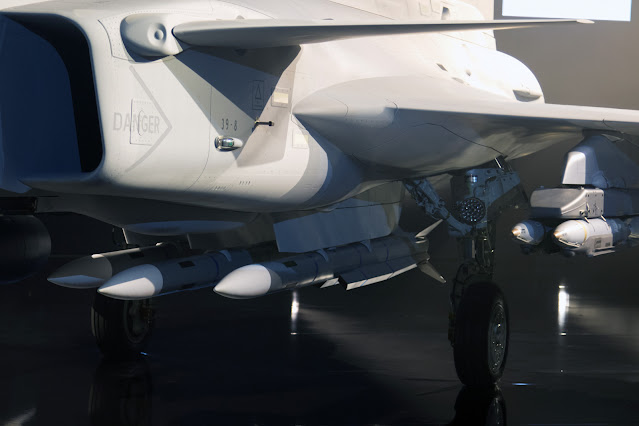
Image
    [Welcome to "NITPICK"!  For the next few weeks I will be examining a single aspect of the potential fighters that just drives me nuts.  These are not dealbreakers, or even major flaws.  They are simply one aspect of the aircraft THAT COULD HAVE BEEN DONE BETTER.] Since we have gone over the (canted) pylon problems with the Super Hornet and the (lack of internal) pylon problems with the JSF, it seems only fair that we nitpick the Gripen's pylon problems as well. There is nothing wrong with the Gripen's pylons per se .  They are certainly there.  They do a serviceable job attaching various weapons to the aircraft.  They all point in the same forward direction (* cough*Super Hornet).   Yet...  There is something unsettling about the Gripen's pylons.   Admittedly, it took a while for me to figure it out.   Even "clean" the Gripen's sleek lines are interrupted by pylons.  Pylons on each wingtip.  Two mor...

BACK TO BASICS: STEALTH AND COUNTERMEASURES

Image
Welcome to "Back to Basics"; an ongoing series in which we will attempt to "get back to basics".  Each week (or so) we will examine one crucial aspect of a fighter and how the fighters vying for Canada's FFCP compare.  For a combat aircraft, speed and maneuverability are important factors in its survivability.  Once detected, a pilot may need to push an aircraft to its limits to avoid enemy fire.  Of course, the simplest way to avoid enemy fire is not get detected in the first place.   Despite its widespread use in all the latest material, the concept of a stealthy aircraft is nothing new.  It began when combat aircraft were first painted in a disruptive camouflage pattern in WWI.  While this may seem basic by today's standards, one must remember that the most effective detection equipment of the day was the Mark I Eyeball .  Up until partway through WWII, one could avoid detection by utilizing...

BACK TO BASICS: MANEUVERABILITY

Image
Welcome to "Back to Basics"; an ongoing series in which we will attempt to "get back to basics".  Each week (or so) we will examine one crucial aspect of a fighter and how the fighters vying for Canada's FFCP compare.  Is there anything more thrilling than watching a fighter jet pull impossibly tight turns, loops, and rolls at mind-boggling speeds?  Maybe a few things come to mind, but not many.  Not a single person watched TOP GUN  for its romantic subplot.   Fighter maneuverability does more than excite people at airshows and make a star out of Tom Cruise.  For the kill-or-be-killed world of fighter combat, agility is requisite for survival.  Like speed, a fighter with superior maneuverability will have better control over the engagement.  A fighter without speed and agility is more likely to become the hunted instead of the hunter.   The purpose of fighter maneuvers is si...

BACK TO BASICS: SENSORS

Image
Early radar mounted on a Me Bf110 Welcome to "Back to Basics"; an ongoing series in which we will attempt to "get back to basics".  Each week (or so) we will examine one crucial aspect of a fighter and how the fighters vying for Canada's FFCP compare.  When comparing modern jet fighters to one another, one tends to focus on the more tangible aspects:  How fast they are, how many weapons they can mount, and how  maneuverable  they are.  Yet  none of these factors really matter until a target is found, identified, and tracked.   For years, a fighter aircraft's sensor suite was limited to pilot's vision.  Not only was 20/20 vision (or better) a prerequisite, but the design of the aircraft itself was an important factor in giving pilots a clear view of the sky around them.  Everything from cockpit position to bubble canopies have been implemented to help improve performance of the " Mark I Eyeball ". ...

BACK TO BASICS: SPEED

Image
Welcome to "Back to Basics"; an ongoing series in which we will attempt to "get back to basics".  Each week (or so) we will examine one crucial aspect of a fighter and how the fighters vying for Canada's FFCP compare.   What makes a fighter aircraft...  A fighter?   The ability to carry offensive weapons is the primary factor, obviously.  So is detection equipment, maneuverability, range, and (recently) stealth.  What really excites our inner 12-year-old when it comes to fighters, however, is speed.   It is a fair assessment.  What good are weapons if you cannot catch up to your target?  A long-range fighter bristling with weapons, sensors, and lots of fuel ends up to be a middling platform without the speed to put it all in play. Since conception, fighter development has focused on speed.  Speed is not only makes a fighter deadly but acts as its greatest defense.  Speed allows a fighter to intercept ene...