Posts

Showing posts with the label F-16

REVISITING THE SINGLE ENGINE DEBATE
Image
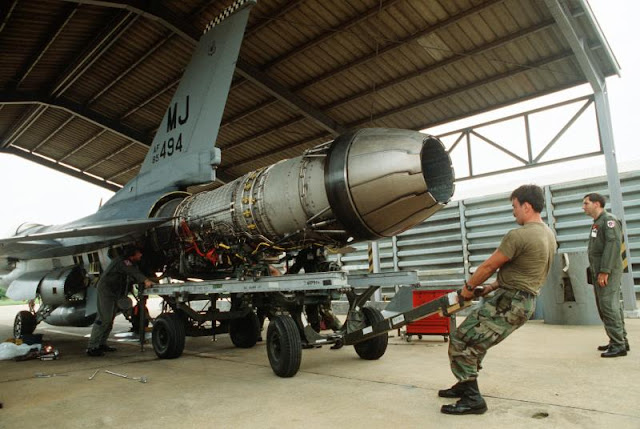
There was nothing Jim enjoyed more than a game of "Pull the Nozzle". There is an oft repeated trope that Canada requires a twin-engined aircraft for "safety reasons".  Some even go so far as to rule out any single-engine  fighter as a replacement for Canada's CF-18 Hornets. This blog has examined the issue before .  While it certainly is not an unfounded opinion, modern jet engine reliability has rendered the argument all but moot.  Both the RCAF and the Government of Canada seemed to agree when they made the infamous decision to sole-source the F-35 Lightning II. When the current Trudeau government campaigned on the promise to cancel the JSF purchase, it was on the grounds of cost, not safety. There are still those that lack confidence in a single-engine layout, however.  Perhaps a stronger argument needs to be made. The best way to make a comparison is to eliminate as many variables as possible.  In this case we will examine two fighters tha...

F-35 CAN'T DOGFIGHT. SUPRISED?

Image
Were you surprised by the recent hullaballoo regarding the F-35's lack of dogfighting prowess?  If so, you have not been paying much attention . Several days ago, an article was posted on the "War is Boring" blogsite entitled:   Test Pilot Admits the F-35 Can't Dogfight .  The article described a 5-page report in which a test pilot criticized the JSF's performance during combat testing against a F-16D Fighting Falcon.  Shortly after, War is Boring published the entire report . Aviation week has hosted the report in PDF form here.  Or you can read it below. F-35 High AoA Maneuvers The exercise, which occurred in January, pitted an early production F-35A (the standard CTOL model) against a Block 40 F-16D.  The F-35 had no stealth coating, nor did it have weapons mounted internally or externally.  The F-16D carried no weapons, but did mount two 370 gallon wing tanks. The F-35A seemed to have every advantage.  Its stealth coating would...

Blast from the past...

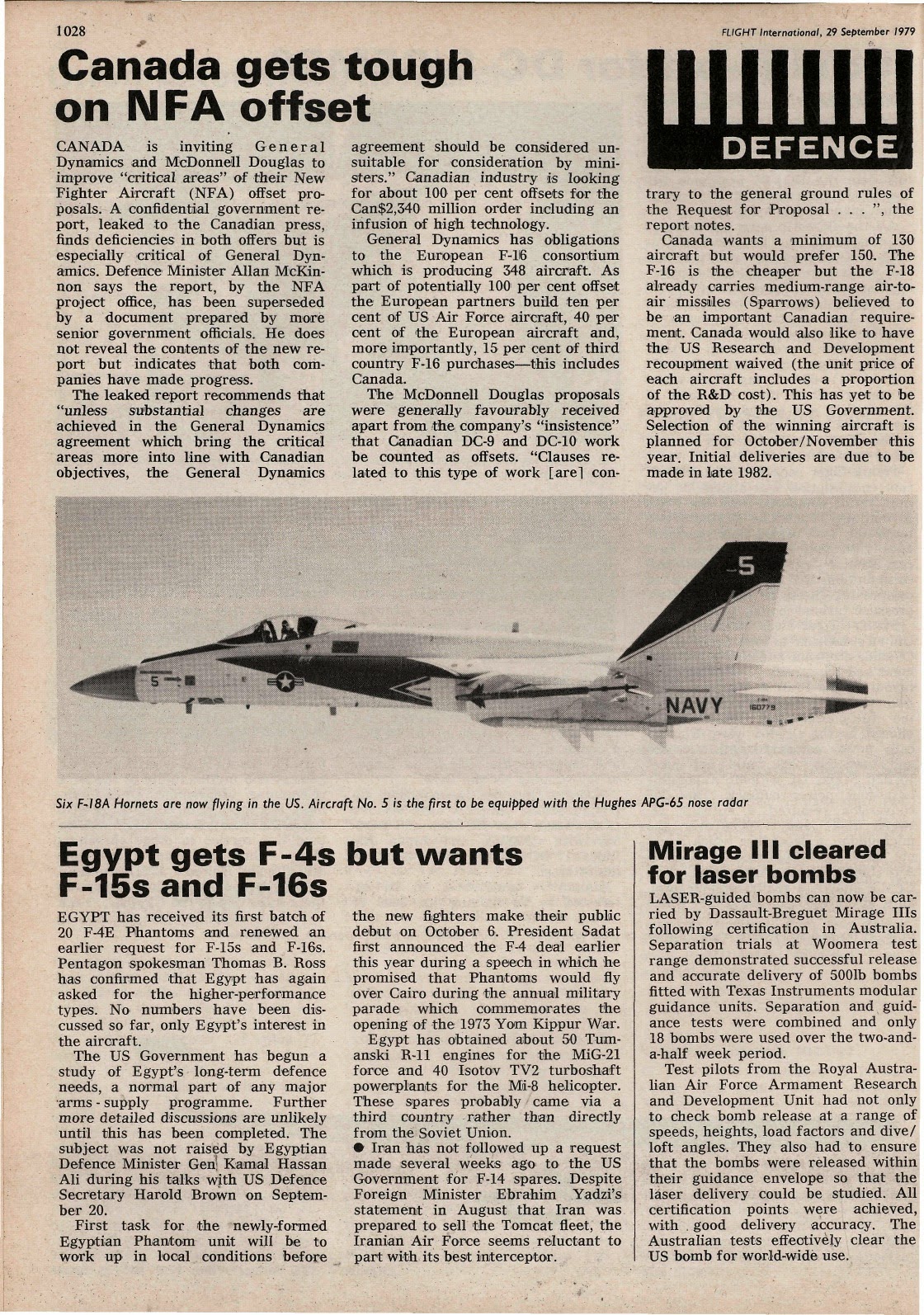
Image
From the Flightglobal archive : Click to enlarge. This news clipping from 1979 says a lot about why the F/A-18 was selected over the F-16.  Quite simply, the Hornet came with more attractive offsets and the AIM-7 BVR missile.  Very much a "big deal" back then. Back in those days the F-16 was still very much a short-range, fair-weather day fighter.  It would not become the multirole fighter we know of today until the F-16CD variants were introduced in the mid-eighties.  The F-16s production numbers would not become stratospheric until the Reagan administration relaxed sales restrictions on military hardware , increasing demand for the Viper internationally.

Mythbuster: Single engine safety

Image
Is one of these a deathtrap? There was a decent crown at the air show today.  It was a beautiful August Saturday, with just the slightest wisps of clouds high up.   "Time to start the show." Captain Buster said to himself as he throttled his trusty CF-18 Hornet demonstrator up and off the tarmac.  Buster had a privilege of following The Snowbirds that day, so he knew he had his work cut out for him.  "No problem." he thought, those 50-year-old CT-114s may have their precision, but the ol' Hornet had raw power on its side.  Captain Buster imagined he could hear the crowd's "Ooohhs!" and "Aahhhs!" over the roar of this after burning GE404 turbofans.  Even after 30 years of service, the Hornet was still an impressive plane.  Its high thrust and high angle-of-attack performance allowed it to perform maneuvers that seemed to contradict the laws of physics.  "Not bad for an old girl..." thought Buster with a smile. ...

Saab bails out of Denmark.

Image
Not going to happen. Saab has declined to enter a bid in Denmark's recently announced fighter competition to replace its aging F-16 fleet. "We are grateful for the invitation to tender, but as on all occasions like this, we have undertaken an analysis of the situation and choose not to respond to the invitation,"  Like Canada, Denmark hit the "reset button" on its F-35 purchase after concerns about the JSF's price, performance, and reliability.  It is now comparing the Eurofighter Typhoon, Boeing Super Hornet, and F-35.  Dassault's Rafale was apparently left out . Saab's exact reasons for declining Denmark's request for binding information (RBI) are unclear, but seems pretty safe to assume that it believes the competition is heavily weighted in the F-35's favor.  Like Canada, Denmark is a "Level 3" industrial partner in the JSF program. It could be more complicated than that, however.   Recent success in Brazil , combine...

South Korea considers leasing old jet to fill F-35 gap.

Image
40 of one, 20 (used) of the other? After announcing a $6.8 billion deal to buy 40 F-35A Lightning II fighters, South Korea is now left with the quandary of filling the gap left in the F-X program.  With the original intent to purchase 60 fighters, South Korea's ROKAF (Republic of Korea Air Force) is left short 20 fighters with only $500 million of its $7.3 billion budget left. In the days of $100 million fighter jets, $25 million (each) doesn't buy you a whole lot.  Not new, anyway. Fortunately for the ROKAF, the USAF has an abundance of F-16s that it can no longer afford to fly thanks to sequestration cuts.  Instead, it has put that money towards other priorities . So now, South Korea is looking to fill its fighter gap by leasing used American F-16s . For those of you following at home, that means: The USAF can't afford to fly some of its F-16s because the F-35 is too expensive. The ROKAF couldn't afford the 60 fighters it wanted because the F-35 was...

Revisionist history... Should we have bought the CF-18?

Image
the CF-18 Hornet really the best aircraft for Canada over the last 30-odd years?  It's hard to imagine the RCAF without it, but the F/A-18 might not have been the best choice at the time.  The truth is that the F/A-18 was merely the "last fighter standing" after several others were dismissed as being unsuitable or too expensive.  Looking back one wonders how things might  have been. Canada's "new fighter aircraft" (NFA) was developed to find a single airframe to replace both the CF-101B used for interceptor duties and the CF-104 used for ground attack (despite the F-104's intended use as an interceptor) and nuclear deterrence in Western Europe.  138 aircraft were planned, with provisions to order more if needed.  Plans to replace the CF-116 (CF-5) Freedom Fighter with the same aircraft was postponed indefinitely. Panavia Tornados in CFB Goose Bay. In 1965, Canada had joined up with Germany, Italy, Belgium, and the Netherlands to ...

Plan B.

Image
For when you've made a bad decision... With the continued threat of US military budget cuts, upper brass at the Pentagon is finally starting to come around to the simple truth...  Current fighter fleets are soldiering on well past their prime, and are requiring life extension programs and upgrades to remain effective.  The JSF is still years away from operational status, with all signs pointing to further delays , and there is a very real possibility of outright cancelation . Reality is setting in...  They might need to find an alternative to the F-35. Their simply isn't time or resources to build an all new design.  The F/A-XX is still years away from any flying prototype, and securing funding for such an undertaking may prove to be a challenge in and of itself.  Any "plan B" will have to be an existing design, or, at the very least, heavily derived from one. USN Super, and Super Duper Hornets. Boeing F/A-18F Super Hornet. This one is ea...