Posts

BUDGET 2016: More kicking of the can.

Image
Well...  That was...   Expected. The Liberal Party of Canada's first  Federal budget  since forming the government is finally here.  To the surprise of pretty much no one, defense spending is once again put on the back-burner.  This, despite an eye-watering $29.4 billion deficit projected for this year. Those hoping for increased funding will have to wait until 2020 before funding for large scale projects (CSPS, CF-18 replacement, etc) takes effect.  This is precariously close to the end of Prime Minister Justin Trudeau's mandate.  In all possibility, this increase in funding could very well hinge on the outcome of the  next  federal election.  (insert groan here) Ugh. One might view this as a possible return to the "Days of Darkness" that occurred under Prime Minister Jean Chretien...  And rightly so. To be fair, however, this budget does not make an about-face in Canadian military spending.  The previous St...

WILL BOMBARDIER FACTOR IN DND'S REBUILDING?

Image
Bombardier C-Series:  Savior or a curse? Any Canadian reading the business news lately knows that Bombardier is in trouble . Layoffs, less-than-hoped demand for the C-Series , and requests for bailouts have made headlines for the Canadian aerospace company.  Some of the blame for this is directed at Bombardier's management practices.  Bombardier utilized a two-tiered investment structure, in which shares owned by its two founding families (Bombardier and Beaudoin) are worth far more than shares available to the general public.  Thanks to this, 13% of the shareholders enjoy a 54% of the voting power.  Combined with Bombardier's niche position in the marketplace, investors are likely to think twice . The question is:  Do we let Bombardier fail? Some may be tempted to let natural selection take its course.  "Darwinism" and all that.  Doing so would pretty much devastate Canada's aerospace industry, however.  Canada would still have pl...

POLITICAL PROBABILITIES

Image
Aviation buffs always get caught up. When the talk centers around fighter aircraft, they debate the merits of each by comparing top speeds, payload capability, wing-loading and such.  By using these empirical measurements, they can argue for their favorite based on hard facts.  Much like buying a car or a microwave, the selection usually comes down to choosing the right balance of features and price. Multi-billion dollar military procurement contracts do not work that way, however. In my last post, I focused on the government ministers whom will be ultimately responsible for Canada's next fighter aircraft acquisition.  Why?  Because politics determine fighter sales far more than stealth or the ability to supercruise. Putting aside each aircraft's performance and other capabilities, how politically  palatable are the CF-18 replacement contenders? F-35, no longer a near-certainty. F-35 Lightning II:  Down but not out. Five years ago, Canada's...

CABINET COMMITTEE PROCUREMENT PEOPLE

Image
Sadly, these guys won't be in charge. When the Liberal government took power late last year, they inherited an extremely troubled military procurement system .  To be fair, that broken system was in turn inherited by Conservative Party of Canada when it came to power back in 2006.  While there may have been a few bright spots along the way , some would argue that Chretien's "Decade of Darkness" for the Department of National Defense has lasted for an entire generation. Thankfully, there are some signs to suggest we may soon see some positive movement. First of all, there is finally some movement in the agonizing process to replace Canada's fixed wing search and rescue (FWSAR) fleet. Next comes word that the government has formed a cabinet committee to look over future high-profile defense purchases .  While a committee can be a place where good ideas go to die, the high profile of the participants may suggest otherwise. Then again, Harjit Sajjan...

REVISITING THE SINGLE ENGINE DEBATE

Image
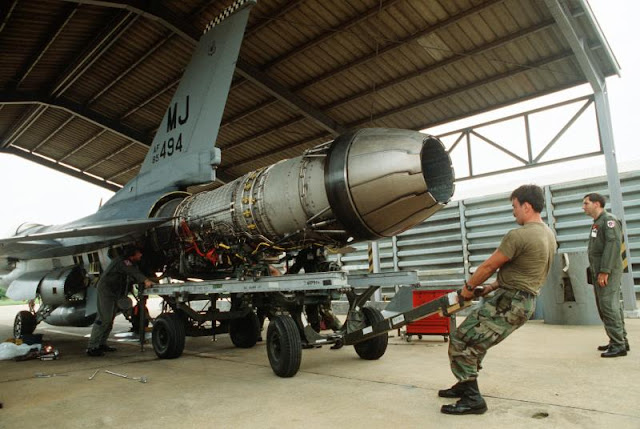
There was nothing Jim enjoyed more than a game of "Pull the Nozzle". There is an oft repeated trope that Canada requires a twin-engined aircraft for "safety reasons".  Some even go so far as to rule out any single-engine  fighter as a replacement for Canada's CF-18 Hornets. This blog has examined the issue before .  While it certainly is not an unfounded opinion, modern jet engine reliability has rendered the argument all but moot.  Both the RCAF and the Government of Canada seemed to agree when they made the infamous decision to sole-source the F-35 Lightning II. When the current Trudeau government campaigned on the promise to cancel the JSF purchase, it was on the grounds of cost, not safety. There are still those that lack confidence in a single-engine layout, however.  Perhaps a stronger argument needs to be made. The best way to make a comparison is to eliminate as many variables as possible.  In this case we will examine two fighters tha...

SHOULD THE F-35 STILL BE CONSIDERED FOR CANADA?

Image
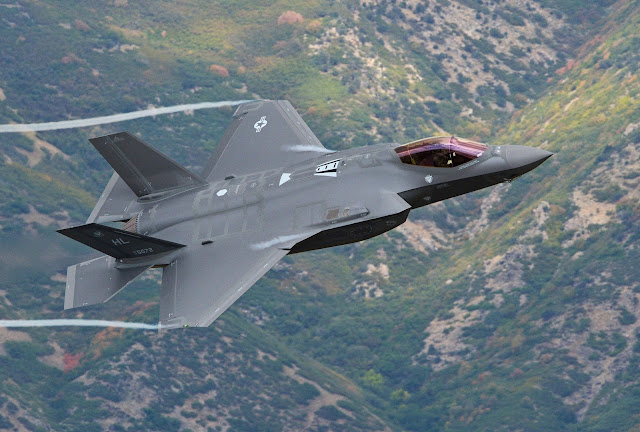
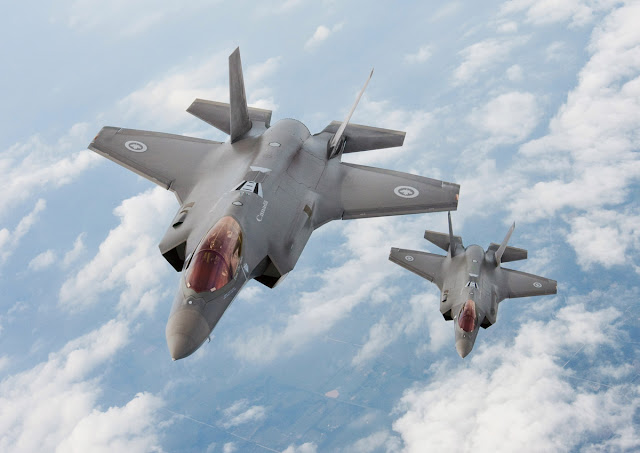
I am not a huge fan of the F-35. Over the years, the F-35 program has been troubled to say the least.  It has gone  over-budget , it is way  behind schedule , and the aircraft's performance has been  underwhelming  so far. Despite the JSF's problems, the Canadian government announced it  would purchase 65 F-35As  in a "sole-source" deal to replace Canada's aging CF-18 Hornets.  Other fighter manufacturers were given a  brief glance , but only after the decision was made to go with the JSF. We all know how that turned out. With the new Liberal government promising to hold an open and transparent competition, the question needs to be asked:  Should the F-35 be given another shot? Of course it should. There is no denying the fact that the F-35 will be the preeminent fighter aircraft of NATO.  With over 3,100 airframes planned, the JSF will see service in the USAF, USN, USMC, RAF, RAAF, IAF, RNLAF, ROKAF, JASDF, RNoAF,...

Raptor for Canada?

Image
Lately, the F-22 Raptor seems be enjoying an upsurge in popularity.   More to the point, some have suggested that F-22s should be bought instead of F-35s .  With the F-35 still facing development issues and unimpressive performance , it is not hard to imagine why.  The argument can even be made that the F-22 was actually cheaper  than the F-35.  Using that reasoning, it would seem like a no-brainer to simply acquire the legendary F-22.   There is very little debate over the F-22's combat effectiveness.  It is the undisputed air-superiority champ.  Fast, maneuverable, and stealthy; the Raptor is still the envy of air forces around the world.  Designed during the Cold War and first flying almost 20 years ago, its capabilities have yet to be equalled.  Even future fighters like the Russian PAK FA and Chinese J-20 may not be able to match the Raptor's lethality.  The F-22 is that damn good. Unfortunately, production ...